American military helmet evolution
If you’ve ever wandered into a gun forum after midnight, you’ve probably seen it: Someone asks “Will a 5.7×28 go through a ballistic helmet?”- and suddenly fifty people become ballistic scientists.
Half swear it’ll “slice through Kevlar like butter,” while the other half are posting slow-mo YouTube clips to prove it won’t. Meanwhile, somewhere in the chaos, a poor Ruger 57 owner just wants to know if their ammo’s good for the range this weekend.
Let’s clear the smoke (and the comment-section drama). The 5.7x28mm FMJ is a fast, flat-shooting little speed demon – but not the armor-melting laser some make it out to be.
In fact, lab data and live-fire testing tell a surprisingly calm story: NIJ IIIA helmets, like the PGD ARCH GEN3, stop standard 5.7×28 FMJ rounds cold – no magic penetration, no Hollywood explosions, just solid ballistic science doing its job.
So grab your coffee, holster your myths, and let’s talk real numbers: performance, penetration, and the protection that actually stands up to it.
Check out the video below where we put a Ruger 57 firing 5.7×28 FMJ to the test on our very own PGD ARCH GEN3 helmet – live-fire, controlled range conditions, and multiple angles. Watch the impacts, see how the composite shell absorbs and disperses energy, and note the outcome (no penetration on standard FMJ loads). As always, these tests were conducted by trained professionals under strict safety protocols – don’t try this at home.
This is part 2/8 in our PGD Ballistic Test Series.
The Ruger 57 pistol, firing 5.7x28mm FMJ rounds, is popular for its flat trajectory, low recoil, and high capacity. Typical 40-grain FMJ loads exit the Ruger 57 at velocities near 1,700 fps, making them effective for target shooting and competition. FMJ penetrates exceptionally well, but hollow-point ammunition performs better for personal defense.
Lab and real-world tests show NIJ IIIA-rated helmets such as the PGD ARCH GEN3 stop standard 5.7×28mm FMJ rounds fired from handguns without full penetration.
This article covers FMJ vs hollow points, practical applications, results from helmet ballistic testing, and what this means for shooters and gear enthusiasts.
The Ruger 57 brought the 5.7x28mm cartridge to a broader audience, combining high-capacity magazines and light recoil with a caliber engineered for speed and penetration. The combination of the Ruger 57 pistol and 5.7x28mm FMJ ammunition has become a favorite pairing for those interested in superior ballistic performance at the range, dynamic shooting sports, and, occasionally, as a defensive option.
The Ruger 57 is a semi-automatic, polymer-frame pistol designed specifically for the 5.7x28mm cartridge. FN Herstal originally developed this cartridge for military and law enforcement, but civilian shooters have increasingly embraced it.
Lightweight and bottlenecked, 5.7×28mm rounds are known for:
FMJ, or “Full Metal Jacket,” refers to projectiles with a soft lead core completely encased in a harder metal shell.
In the context of the 5.7x28mm, this jacket typically covers the entire bullet except for its base. Shooters value FMJ rounds for:
Several manufacturers produce 5.7x28mm FMJ loads optimized for pistols:
These loads are widely available and offer shooters a good mix of velocity, reliability, and cost-efficiency for high-volume use.
The 5.7x28mm FMJ stands out for its speed, flat trajectory, and manageable recoil, making it an attractive option for multiple shooting disciplines.
Out of the Ruger 57’s 4.94-inch barrel, the typical 40-grain FMJ produces the following results:
These characteristics give the 5.7×28 FMJ a distinct edge for shooters who value long-range handgun performance.
From the bench or practical shooting positions, shooters report:
5.7×28 FMJ is a go-to choice for:
Choose FMJ or hollow points based on whether you prioritize range performance, penetration, or self-defense.
If you missed our part 1/8 in our PGD Ballistic Test Series, read this article “Ruger 57 5.7×28 GDHP: Performance, ballistics, and PGD helmet test results“.
FMJ:
Hollow Point:
With its reputation for high velocity and penetration, the 5.7x28mm FMJ round frequently prompts questions about its performance against ballistic protection. The answer comes down to standardized testing and real-world demonstrations, including live-fire helmet test series on products like the PGD ARCH GEN3.
Ballistic helmets, including the PGD ARCH GEN3, are rated under the NIJ (National Institute of Justice) standard IIIA. This specifies protection against the most common handgun threats:
Want to learn more about NIJ protection levels? Head over to the PGD Blog and check out our article “Level IIIA Ballistic Helmet Explained” for a full breakdown of what the rating means and how it’s tested.
A series of industry-standard and independent live-fire helmet test series have verified NIJ IIIA helmets’ effectiveness against 5.7×28 FMJ rounds fired from pistols:
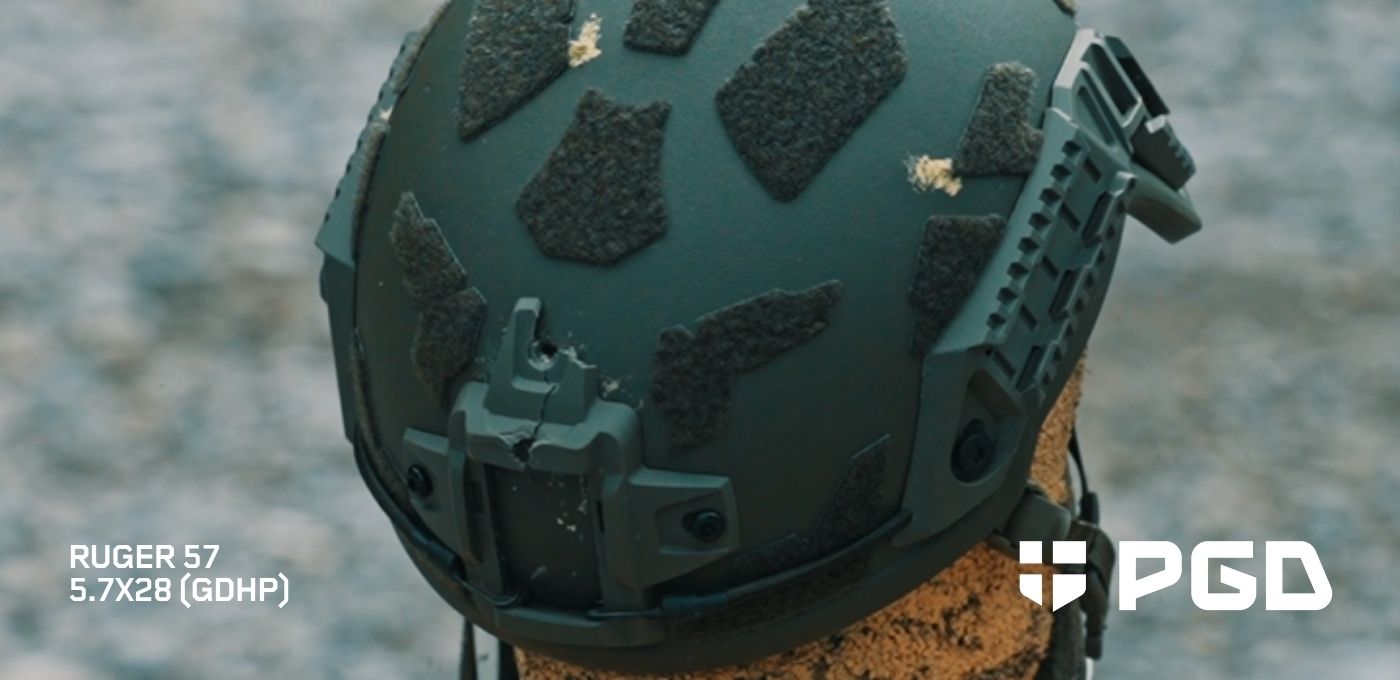
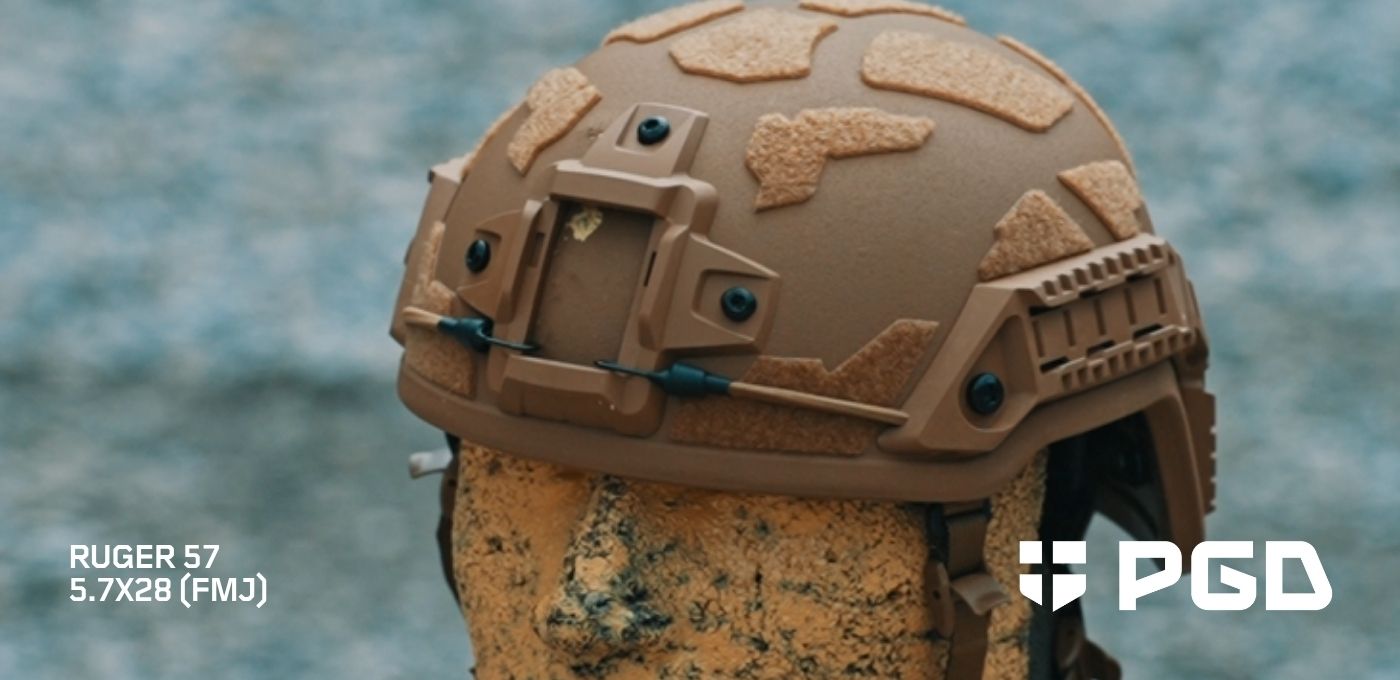
In our controlled live-fire PGD ARCH ballistic test series, the PGD ARCH GEN3 Ballistic Helmet was subjected to multiple direct hits from factory 5.7×28 FMJ ammunition:
For shooters, law enforcement, and security teams selecting a helmet that can hold up under direct 5.7×28 FMJ fire, this is a major factor in operational planning and personal confidence.
Check out the pictures below.


For anyone wanting reliable head protection from high-velocity rounds – including those fired by the Ruger 57 with 5.7×28 FMJ – the PGD ARCH GEN3 stands as a proven solution with validated, repeatable performance under stress.
Want to know how our gear performs outside the test range? Visit our “What They Say” page to read genuine reviews from professionals, law enforcement officers, and dedicated shooters who rely on PGD equipment every day. Their firsthand experiences offer valuable insight into how our helmets, and accessories perform under real-world conditions – from training grounds to operational deployments.
The PGD ARCH GEN3 Ballistic Helmet delivers a comprehensive set of features for professionals and demanding enthusiasts:
Our ballistic helmets undergo extensive laboratory testing, but with this series, we decided to take it one step further.
In collaboration with CWS Tactical , we subjected the PGD ARCH helmet to real live-fire testing to demonstrate its true performance under pressure.
The test profile: 8 videos with shots fired from a distance of 5 meters, with five direct impacts targeting the front, left, right, back, and crown of the helmet.
Because protection isn’t proven on paper – it’s proven under fire.
All testing was conducted at professional training facilities under strict safety supervision. Do not attempt to replicate these tests.
Explore our complete ballistic gear lineup at Protection Group Denmark.
FMJ, or “Full Metal Jacket,” refers to projectiles with a soft lead core completely encased in a harder metal shell. In the context of the 5.7x28mm, this jacket typically covers the entire bullet except for its base. FMJ rounds are highly valued for consistent feeding and reliability in semi-auto pistols like the Ruger 57, minimal expansion resulting in deeper penetration, and cost-effective bulk purchasing for practice and training.
FMJ exhibits deep penetration with virtually no expansion, making it useful for training and situations where full penetration is desired. However, over-penetration is a risk in defensive situations. Hollow point is designed to expand on impact, increasing wound channel size while usually reducing the risk of over-penetration. Premium 5.7x28mm hollow point loads are engineered for more effective personal defense. FMJ is reliable and lower cost but less effective for self-defense due to lack of expansion, while hollow points offer controlled expansion and generally better terminal performance in soft targets but are more expensive and can have less reliable feeding in some firearms.
NIJ IIIA-rated helmets, such as the PGD ARCH GEN3, have been proven in both lab and real-world tests to stop standard 5.7x28mm FMJ rounds from handguns without full penetration. A series of industry-standard and independent live-fire helmet test series have verified NIJ IIIA helmets’ effectiveness against 5.7×28 FMJ rounds fired from pistols, with no through-penetration when standard 40-grain FMJ is shot at these helmets at close range with weapons matching Ruger 57 specs.
When a 5.7x28mm FMJ fired from a Ruger 57 strikes an NIJ IIIA-rated helmet such as the PGD ARCH GEN3, the FMJ’s high velocity is dissipated by the helmet’s multi-layer composite, trapping the bullet before it can exit the interior shell. The wearer may feel the impact and experience limited backface deformation, but no penetration occurs. The helmet remains functional, offering real-world assurance to military, law enforcement, and prepared civilians using such ammunition in potential threat scenarios.
Protect what matters.
We’ve moved our U.S. sales
Protection Group Denmark products are now available in the United States exclusively through our official distributor, Colorado Gun Fighter. This store is no longer accepting new orders — please continue your purchase there.
Already placed an order with us? Don’t worry — all existing orders will be fulfilled as normal.
Shop at Colorado Gun Fighter