
Ballistic helmet visor: Complete guide to tactical face shield protection
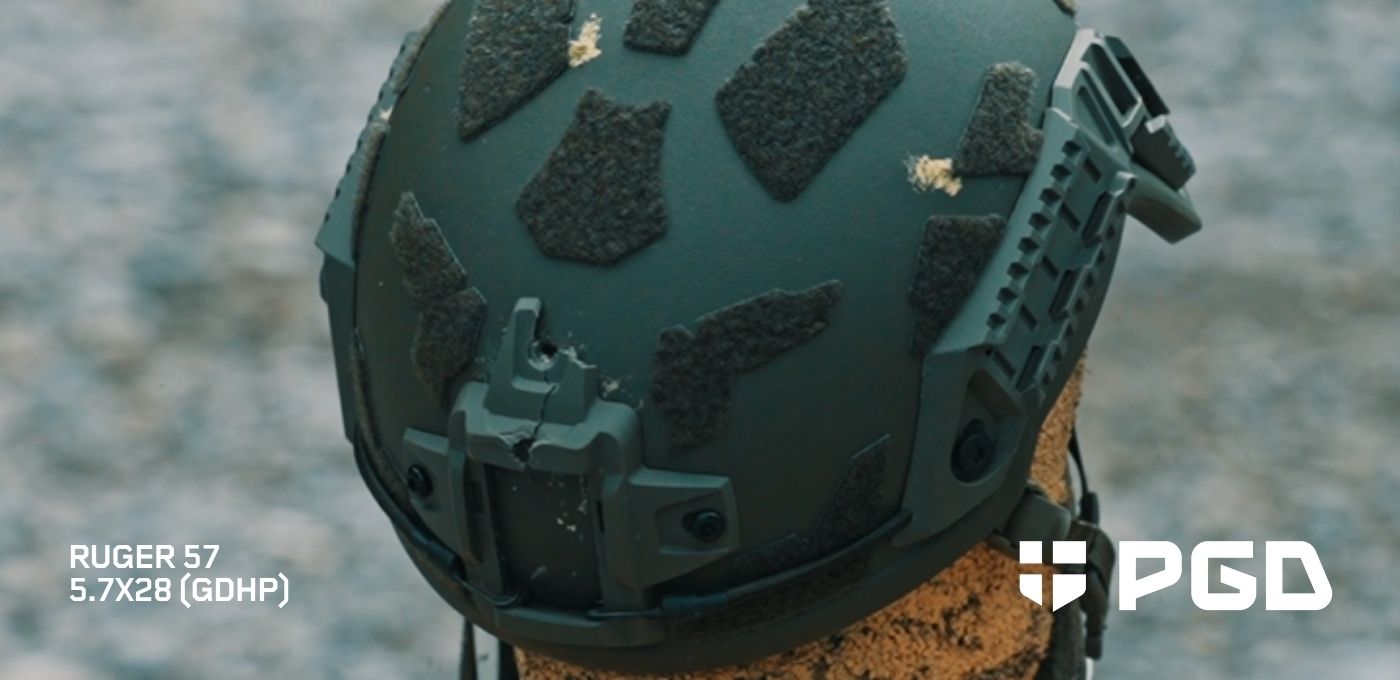
Ever wonder what happens when a high-speed 5.7×28 round meets a ballistic helmet built to say “not today”?
We decided to find out the old-fashioned way – by actually shooting it.
That’s right: We took a Ruger 57, loaded it with Speer Gold Dot Hollow Points, and sent rounds downrange straight into a PGD ARCH GEN3 helmet. No CGI, no fancy simulations – just lead, Kevlar, and curiosity.
The result? Let’s just say our helmet walked away with bragging rights. The 5.7 flew fast, the camera guy flinched, and everyone at the range suddenly wanted one of these lids.
Check out the video below, then stick around as we break down how the Ruger 57 performs, what makes 5.7×28 GDHP so unique, and why the PGD ARCH GEN3 earned a serious reputation in our live-fire test.
This is part 1/8 in our PGD Ballistic Test Series.
The Ruger 57 5.7×28 GDHP pairs high velocity, flat shooting, and low recoil with real-world defense potential.
This article breaks down its features, ballistics, and hands-on ammo test results, especially against ballistic helmets.
In-house testing of the PGD ARCH GEN3 Ballistic Helmet demonstrated it could stop 5.7×28 Gold Dot Hollow Point rounds without penetration – a unique level of protection for this category.
Learn whether this platform fits your needs in defense, how GDHP ammo works, and what to consider regarding helmet and ammo selection for personal or professional use.
Combining the Ruger 57 pistol with true defensive-grade 5.7×28mm Gold Dot Hollow Point (GDHP) ammunition has given rise to a configuration that straddles the line between innovative sport performance and practical self-defense.
Below, we break down what makes the Ruger 57 unique, how GDHP ammo differs from standard loads, and why this combination has caught the attention of shooters seeking both speed and security.
The Ruger 57 is a full-size, semi-automatic pistol chambered in the increasingly popular 5.7×28mm cartridge.
Its standout features include:
With its high magazine capacity, low recoil, and user-friendly design, the Ruger 57 expands high-velocity 5.7×28 performance into a familiar pistol platform.
The 5.7×28mm Gold Dot Hollow Point (GDHP) is a premium defense-oriented loading designed by Speer.
To answer a common question:
What does GDHP mean?
This expansion is what differentiates GDHP from standard FMJ 5.7×28 rounds, and it’s critical for anyone considering the 5.7 platform for lawful personal defense.
Why do shooters choose the Ruger 57 and GDHP ammo over other setups?
Three main reasons stand out:
If you value speed, capacity, and the potential to defeat intermediate barriers, this pairing is worth a close look.
Performance on paper only goes so far. The following section breaks down how the 5.7×28 GDHP stacks up against other pistol rounds, its real-world ballistic energy, and key considerations for self-defense applications.
The 5.7×28 GDHP round achieves its reputation through a unique blend of speed and controlled terminal effect:
Contrast this with a standard 9mm 124gr defensive load at around 1,150 fps and 364 ft-lbs, and the 5.7×28 GDHP brings higher speed but with lighter projectiles. While its raw energy is slightly less, the high velocity provides notable penetration – one aspect the platform is known for.
The results speak for themselves.
After multiple direct impacts from live 5.7×28 rounds, the PGD ARCH helmet showed no penetration and only minimal backface deformation.
The shell absorbed and dispersed the energy exactly as designed, maintaining structural integrity across every hit zone – front, sides, back, and crown. This outcome demonstrates not just compliance, but true real-world protection: the kind of performance that can mean the difference between injury and survival when it matters most.


Our ballistic helmets undergo extensive laboratory testing, but with this series, we decided to take it one step further.
In collaboration with CWS Tactical , we subjected the PGD ARCH helmet to real live-fire testing to demonstrate its true performance under pressure.
The test profile: 8 videos with shots fired from a distance of 5 meters, with five direct impacts targeting the front, left, right, back, and crown of the helmet.
Because protection isn’t proven on paper – it’s proven under fire.
All testing was conducted at professional training facilities under strict safety supervision. Do not attempt to replicate these tests.
Ready to dive deeper? Explore more product details, technical data, and field-test results on armor, weapon pairings, and the newest ballistics advancements. Find lots of articles on our PGD Blog.
Discover the full specs, protection ratings, and product details of the PGD ARCH GEN3 Ballistic Helmet.
Take a detailed look at our latest information, product development, and articles at Protection Group Denmark. Find guides on helmet selection, see live fire results, and access trusted resources for your personal or professional protection needs.
Standard NIJ IIIA helmets may not consistently stop 5.7×28, especially FMJ types—partial or full penetrations can occur. Against expanding GDHPs, results are better, but very few helmets have proven full-stopping power in live-fire, especially with minimized back face deformation (BFD).
GDHP stands for Gold Dot Hollow Point. It’s a bullet engineered with a bonded lead core and a true hollow nose cavity, designed to expand reliably upon impact.
Pros:
Cons:
In Protection Group Denmark’s in-house, independent live-fire ammo test, the PGD ARCH GEN3 Ballistic Helmet was subjected to direct impacts from Ruger 57 5.7×28 GDHP rounds: No full penetration occurred. The helmet caught the expanded GDHP projectiles, preventing them from breaching the inner liner. Back Face Deformation measurements stayed within strict European VPAM/NIJ guidelines, meaning the helmet prevented life-threatening blunt trauma as well as penetration.
Protect what matters.
We’ve moved our U.S. sales
Protection Group Denmark products are now available in the United States exclusively through our official distributor, Colorado Gun Fighter. This store is no longer accepting new orders — please continue your purchase there.
Already placed an order with us? Don’t worry — all existing orders will be fulfilled as normal.
Shop at Colorado Gun Fighter