What is a helmet retention system and why does it matter for ballistic protection?
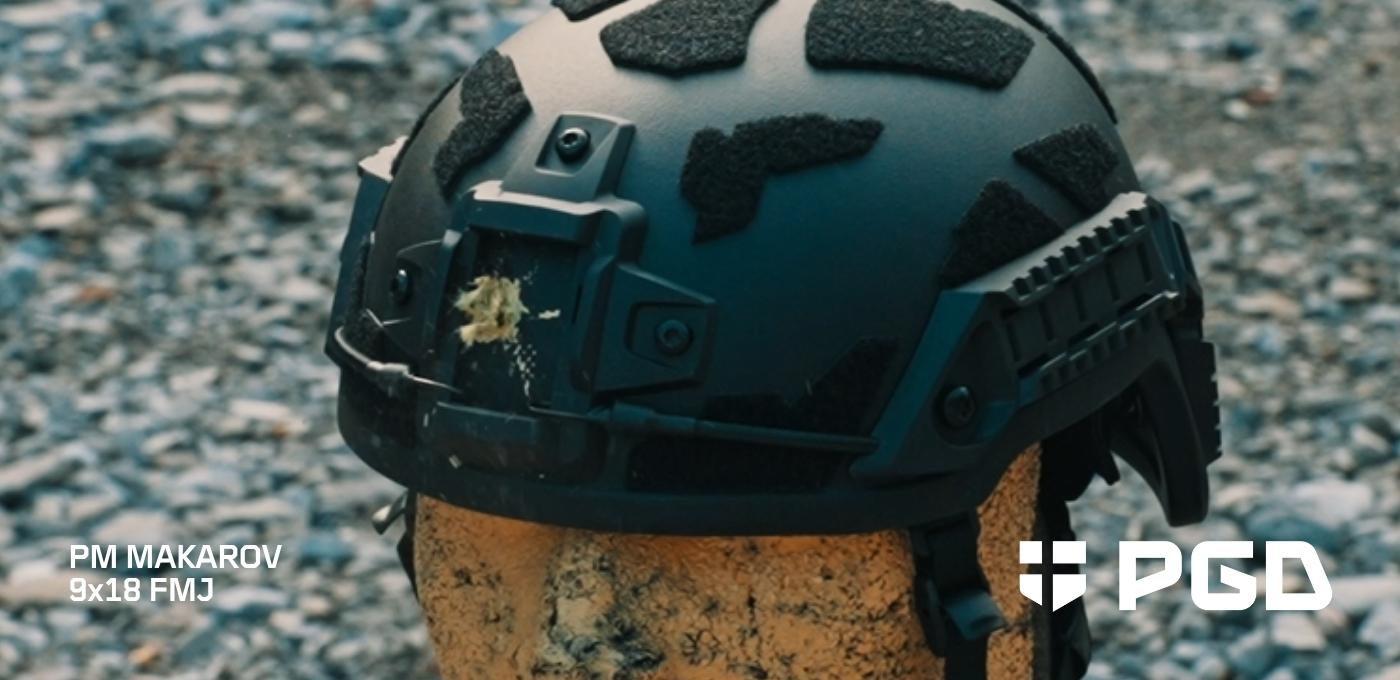
If you’ve ever wondered what happens when Cold War firepower meets 21st-century headgear, you’re in the right place. Picture this: a grizzled PM Makarov from the 1950s glaring across the range at a sleek PGD ARCH GEN3 helmet, muttering in Russian, “You can’t stop me.” The helmet just stares back, calm and composite-layered, whispering, “Try me.”
For decades, the 9×18 mm Makarov FMJ was the go-to round of the Eastern Bloc – simple, reliable, and about as subtle as a tank parade. But times have changed. Today, modern helmets don’t just shrug off this once-feared pistol round – they turn it into a safety demo.
Still, before anyone starts poking fun at Soviet engineering, it’s worth remembering that the Makarov and its 9×18 FMJ were built for rugged, no-nonsense reliability – kind of like the AK’s polite little cousin.
So in this article, we’re putting history and hardware on the same firing line: the classic PM Makarov versus the modern ballistic helmet.
The PM Makarov paired with 9x18mm FMJ ammo remains a widely recognized Soviet-era combination valued for reliability and steady penetration. Its FMJ load doesn’t expand but offers deep penetration and consistent cycling in simple pistols. While common in various military, police, and civilian hands, its ballistic energy is outclassed by modern 9mm Luger rounds. Contemporary NIJ IIIA helmets, like our PGD ARCH GEN3, are specifically designed and tested to resist 9x18mm Makarov FMJ rounds, which they stop without penetration under typical conditions. Nevertheless, blunt trauma risk from non-penetrating hits makes helmet engineering critical. For American shooters curious about both firearm and helmet performance, understanding the real-world interaction of 9x18mm FMJ with proven helmets is vital.
Let’s see how a mid-century Soviet sidearm stacks up against the kind of protection today’s operators, officers, and tactically-minded civilians rely on.
Spoiler alert: our PGD helmet wins – but the science (and the bruising physics behind it) make it worth the read.
As always, these tests were conducted by trained professionals under strict safety protocols – don’t try this at home.
This is part 3/8 in our PGD Ballistic Test Series.
The 9×18 mm Makarov full metal jacket (FMJ) round occupies a distinct place in global pistol history. Recognized for its steady ballistics and straightforward design, this cartridge powered service pistols and submachine guns for decades – especially in the hands of Eastern Bloc military and police.
After World War II, the Soviet Union set out to replace its aging 7.62×25mm Tokarev cartridge and service pistols with something more manageable for mass-issue sidearms.
The result? The 9x18mm Makarov cartridge, officially adopted alongside the PM Makarov pistol in 1951.
Unlike the Western 9mm Luger, the 9x18mm offers lower pressure and energy, fitting a simple blowback pistol design that was cheaper to produce and maintain. Over time, this chambering spread across the USSR, Eastern Europe, and eventually trickled into civilian markets.
The standard 9×18 mm Makarov FMJ consists of:
The FMJ design – enclosing a lead core with a metallic jacket – offers better feeding reliability in simple pistols like the PM Makarov and ensures consistent penetration.
Throughout its service life, the 9x18mm Makarov FMJ has seen use in:
Millions of rounds exist globally, keeping the 9x18mm Makarov FMJ relevant for collectors, shooters, agencies, and those relying on legacy arms.
Performance data, penetration, and on-target behavior matter for evaluating both weapon and armor viability. Understanding 9×18 mm Makarov ballistics gives shooters and procurement teams context for threat mitigation today.
The PM Makarov 9×18 FMJ round typically produces:
For comparison, 9mm Luger (Parabellum) usually delivers 115–124 grain FMJ bullets at speeds up to 1,200 fps, pushing energy levels to 350+ ft-lbs.
In short, PM Makarov 9×18 FMJ is less powerful than standard-pressure 9mm, but offers enough punch for reliable penetration in soft mediums.
In essence, the 9×18 Makarov full metal jacket is most likely to challenge barriers and soft armor due to its retained shape and velocity at close range.
Overall, when testing the limits of any defensive helmet, this cartridge’s “straight-through” ballistics make it a relevant test round.
For anyone relying on head protection, whether officer, soldier, or prepared civilian, the PGD live-fire helmet test series question is crucial: Can the FMJ from a PM Makarov – or similar handguns – defeat today’s advanced helmets?
The National Institute of Justice (NIJ) sets the American standard for ballistic helmet threats. NIJ Level IIIA is the highest soft armor protection currently certified for ballistic helmets, designed to stop:
During NIJ certification, helmets are subjected to close-range impacts from designated ammo types, including 9x18mm Makarov ballistics, demanding no bullet penetration and strict controls on energy transfer to the head.
The PGD ARCH GEN3 Ballistic Helmet is engineered to exceed NIJ IIIA standards, making it a proven barrier to 9×18 mm Makarov ammo.
Here’s why:
The PGD ARCH GEN3 reliably stops PM Makarov 9×18 FMJ and below muzzle velocities, preventing both penetration and catastrophic injury. It’s a direct answer for those doubting whether modern helmets can defeat classic Soviet “ball” rounds.
While the PGD ARCH GEN3’s performance is robust, helmet results can vary based on:
Still, quality Level IIIA helmets – especially those like the ARCH GEN3, rigorously tested with 9×18 mm Makarov FMJ – are considered reliable shields against this threat.
Helmets often “win on paper.” Yet, in a true life-or-death encounter, what does it feel like to take a hit – specifically from a 9×18 Makarov full metal jacket – while wearing a modern helmet?
When a bullet strikes a helmet and is stopped, energy transfers into the shell and then to your head. This causes the helmet to bulge inward – a phenomenon called backface deformation (BFD). The NIJ limits allowable BFD (usually below 25mm) to prevent lethal trauma.
PGD ARCH GEN3 helmets minimize this effect through:
In our PGD live-fire helmet test series, even when stopping 9×18 mm Makarov FMJ or more powerful rounds, our PGD ARCH helmets keep deformation – and thus injury risk – low.
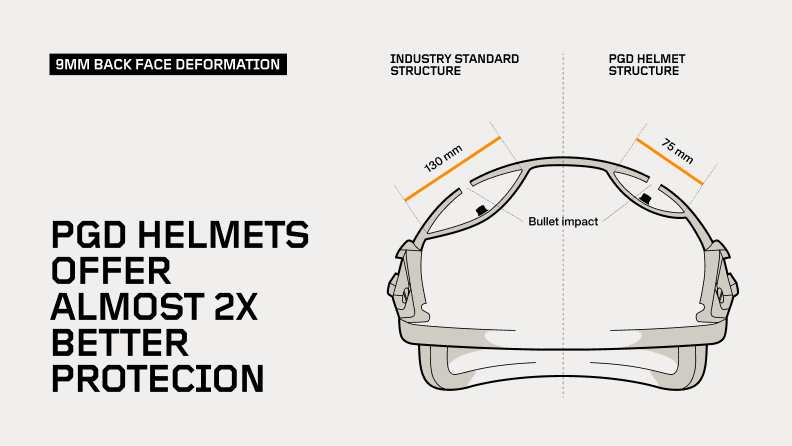
Want to dive deeper into backface deformation and why it matters? Check out our PGD Blog article, “The Critical Role of Backface Deformation in Ballistic Helmet Protection.” It breaks down the science behind blunt-force trauma – and how modern helmets are designed to prevent it.
Helmet design is as much about internal systems as shell material. Here’s where PGD sets itself apart:
A well-designed interior directly reduces the likelihood of concussion or skull fracture, even if 9×18 mm Makarov FMJ doesn’t penetrate the shell.
Stopping a bullet doesn’t guarantee you’ll walk away. With non-penetrating hits, the following risks remain:
This underscores why the combination of a strong shell, proven materials, and premium interior systems – like found in the PGD ARCH GEN3 – is necessary for true mission-ready protection, not just for stopping penetration but for minimizing overall injury.
In our controlled live-fire helmet test series, the PGD ARCH GEN3 Ballistic Helmet underwent multiple direct impacts from factory-loaded 9×18 mm Makarov FMJ rounds:
For operators, law enforcement, and armed professionals facing legacy threats like the PM Makarov, this level of certified resistance is a key factor in reliable head protection.
Check out the pictures below.


Our ballistic helmets undergo extensive laboratory testing, but with this series, we decided to take it one step further.
In collaboration with CWS Tactical , we subjected the PGD ARCH helmet to real live-fire testing to demonstrate its true performance under pressure.
The test profile: 8 videos with shots fired from a distance of 5 meters, with five direct impacts targeting the front, left, right, back, and crown of the helmet.
Because protection isn’t proven on paper – it’s proven under fire.
All testing was conducted at professional training facilities under strict safety supervision. Do not attempt to replicate these tests.
How do the facts about the PM Makarov 9×18 FMJ and live-fire helmet test series apply to your gear selection and operational planning?
While no longer standard-issue in most modern militaries, 9x18mm Makarov FMJ persists through:
Production of 9x18mm Makarov FMJ continues, though at lower levels than 9mm Luger, ensuring its presence on today’s ranges and in conflict zones.
Not all protective headgear is created equal – especially against proven military rounds like the PM Makarov 9×18 FMJ. The PGD ARCH GEN3 Ballistic Helmet stands out with:
Whether you’re an agency shooter or a private citizen concerned about 9×18 mm Makarov ballistics, PGD’s headgear represents the modern standard for safety and mission flexibility.
Head protection is too critical to gamble on second-best. For NIJ IIIA helmets meticulously tested for PM Makarov 9×18 FMJ performance, turn to Protection Group Denmark.
Contact Protection Group Denmark for documentation, threat-matching, and bulk agency procurement support, or to explore your individual headgear options – with transparent data on how each helmet fairs against 9x18mm Makarov FMJ and beyond.
The PM Makarov 9×18 FMJ endures as a significant global handgun round, known for its reliable penetration and deep roots in both conflict and defense. However, modern NIJ IIIA helmets – especially those like the PGD ARCH GEN3 proven in the toughest live-fire helmet test series – routinely stop this classic threat without penetration.
For shooters, security professionals, and anyone tasked with purchasing protective gear, the data is clear: 9x18mm Makarov FMJ may remain a viable and relevant cartridge, but it’s no match for a rigorously engineered, properly fitted, and thoroughly tested ballistic helmet.
Ready to upgrade or verify your ballistic protection? Review PGD ARCH GEN3 Ballistic Helmet specs, or consult with Protection Group Denmark today for headgear that meets both history’s and tomorrow’s threats.
Stay informed – stay protected.
Contemporary NIJ IIIA helmets, like the PGD ARCH GEN3, are specifically designed and tested to resist 9x18mm Makarov FMJ rounds, which they stop without penetration under typical conditions. Test reports from the PGD ARCH GEN3 show the helmet reliably stops PM Makarov 9×18 FMJ at and below muzzle velocities, preventing both penetration and catastrophic injury.
Production of 9x18mm Makarov FMJ continues, though at lower levels than 9mm Luger, ensuring its presence on today’s ranges and in conflict zones.
Throughout its service life, the 9x18mm Makarov FMJ has seen use in military and police sidearms, submachine guns, civilian self-defense (especially in imported surplus handguns), and training, range, and surplus sales due to widespread post-Soviet availability.
Stopping a bullet doesn’t guarantee you’ll walk away. With non-penetrating hits, the following risks remain: blunt-force trauma (which can cause concussion, bruising, or soft-tissue injury), neck injuries (energy transfer may jolt the head and strain the neck), and temporary disorientation (even if the skull is unharmed, rapid deceleration can cause confusion or brief incapacitation).
Protect what matters.
We’ve moved our U.S. sales
Protection Group Denmark products are now available in the United States exclusively through our official distributor, Colorado Gun Fighter. This store is no longer accepting new orders — please continue your purchase there.
Already placed an order with us? Don’t worry — all existing orders will be fulfilled as normal.
Shop at Colorado Gun Fighter