Discover the highest rated ballistic helmet: Independent lab tests & top brand reviews
In this article, we break down what backface deformation actually means – without the lab coat and clipboard. If you’ve ever wondered how a helmet can stop a bullet but still rattle your brain, this one’s for you.
We’ll cover why BFD matters, how it’s tested, what the NIJ says about it, and how PGD’s ARCH GEN3 helmet manages to keep your head safer without turning it into a crash test dummy. Let’s get into it.
Backface deformation (BFD) measures how much a ballistic helmet indents inward when stopping a bullet, reflecting the force transferred to the wearer. Helmets that keep BFD low offer better protection against blunt force trauma and brain injury, even if no penetration occurs. The NIJ and other global standards set maximum BFD depths to prevent severe injuries, but advanced materials and designs go further to minimize BFD while keeping helmets lightweight. PGD’s ARCH Gen3 helmet leads the field by combining high-performance fibers, proprietary layering, and innovative foam to consistently outperform safety limits. Choosing the right helmet means understanding BFD and how real test data translates to real protection.
Let’s start with the fan favorite: the question we get asked more than anything else.
What is backface deformation?
Backface deformation (BFD) refers to the inward bulge that forms on the inner surface of a ballistic helmet when it stops a bullet or fragments. While the projectile does not penetrate the helmet, the energy from the impact causes the helmet’s materials to flex or deform, transferring some force to the wearer’s skull. The depth of this indentation is critical: even if the helmet prevents penetration, excessive BFD can deliver dangerous blunt impact to the head – leading to trauma impact or concussive injury.
One of the best ways to understand backface deformation is to see it in action. Watch the YouTube video below for a real-world demonstration.
In the video from Weapon Works LLC, the PGD ARCH GEN 3 helmet is pushed to its limits across multiple threat types – including 9 mm, .44 Magnum, and even rifle-rated 5.56 rounds – under the Level IIIA protection standard. Viewers get an up-close look at how this helmet handles real-world ballistic challenges, from handgun calibers all the way to high-velocity rifle impacts. The footage showcases not just whether the shell stops the round, but also how well it controls backface deformation – making it a compelling watch for anyone assessing blunt force trauma mitigation and helmet resilience.
So… BFD is a key performance metric because it provides a direct measure of blunt force trauma risk for the user. If the helmet allows too much deformation, the kinetic energy can still cause severe injury, including skull fracture or traumatic brain injury, highlighting why BFD is as important as stopping penetration for head protection.
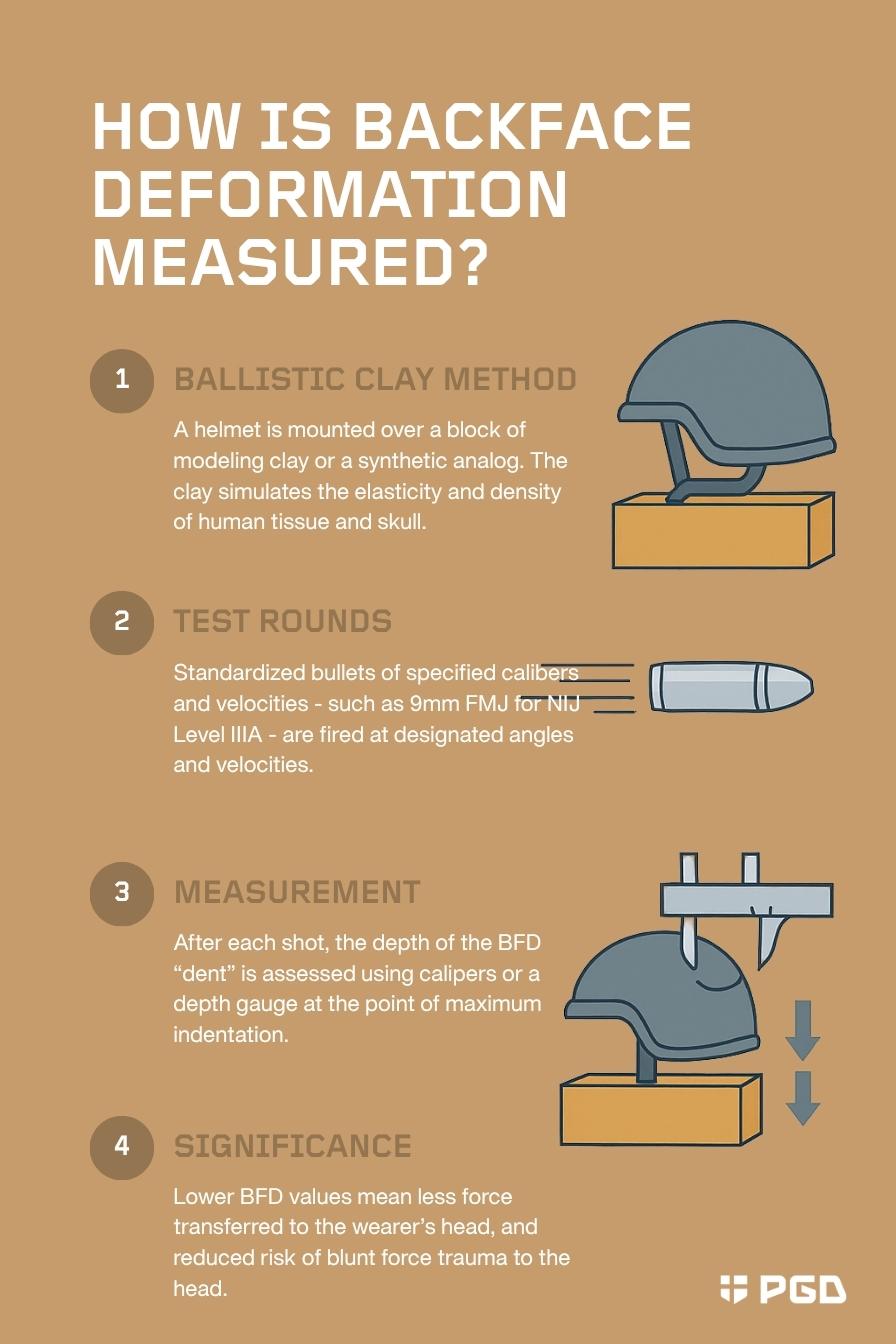
Backface deformation is measured through ballistic testing using a precise methodology:
Test results are critical for procurement officers and end-users. Beyond “pass/fail” ratings, understanding the actual BFD figures helps to compare true blunt impact protection between different helmet models or manufacturers.
Stopping a bullet is impressive – but it’s only half the job. Just because a round doesn’t punch through your helmet doesn’t mean your brain’s off the hook. The impact force still has to go somewhere, and if backface deformation (BFD) gets out of hand, that “somewhere” is straight into your skull.
Too much BFD means you’re trading one problem (penetration) for another:
That’s why BFD isn’t just a lab number – it’s a real-world safety factor. A truly protective helmet doesn’t just stop the bullet; it makes sure your head isn’t paying the price for it.
In this section, we break down the NIJ’s backface deformation (BFD) limits, why they matter for helmet selection, and how global benchmarks are raising the bar for real-world protection. Whether you’re buying for a tactical unit or evaluating specs for a tender, understanding these standards is key to making the right choice.
The National Institute of Justice (NIJ) defines the leading U.S. ballistic standards for helmet performance, including strict requirements on backface deformation:
Manufacturers must report maximum BFD readings during certification testing. Most high-end helmets strive to stay well below the 25mm mark to further decrease the risk of blunt force trauma.
For law enforcement, military, and rescue organizations, understanding backface deformation limits is essential when specifying or selecting ballistic helmets. Regulations shape purchasing decisions in several important ways:
Choosing equipment without verified BFD data can leave critical “gaps” in head protection – even if the helmet stops bullets.
Globally, standards for BFD in ballistic helmets are becoming increasingly strict. Let’s have a look:
Many require BFDs well below 25mm, especially for special operations or urban police use.
Some contracts stipulate BFD maximums of 20mm or stricter for critical areas of the helmet.
Germany (VPAM), UK (CAST), and other leading authorities set their own performance thresholds, sometimes tightening BFD acceptance criteria faster than the U.S.
There is a clear trend toward prioritizing both peak ballistic resistance and minimized BFD for real-world blunt impact protection and trauma reduction.
The result? Helmets today aren’t just built to pass the test – they’re built to flex on it. Engineers are mixing lightweight materials with next-level energy dispersion like it’s a Michelin-star recipe, all to make sure your brain stays right where it belongs. The outcome? Less trauma, more uptime, and a helmet that doesn’t just meet the standard – it side-eyes it and says, “That all you got?”
The shell material of a ballistic helmet plays a central role in how much backface deformation occurs during ballistic impact:
Optimizing material choice is foundational for achieving superior BFD results, but design and manufacturing techniques are equally important.
Advanced ballistic helmets incorporate specialized layering and construction techniques:
By precisely controlling these variables, helmets can consistently outperform minimum BFD limits. The goal: deliver blunt impact protection efficiently and with manageable system weight, which is critical for user comfort and operational speed.
Shell performance is only part of the answer in reducing BFD and trauma impact. Interior helmet padding is engineered specifically to mitigate blunt force trauma to the head:
Together, these innovations reinforce the critical link between test BFD numbers and real-world blunt force trauma outcomes for wearers.
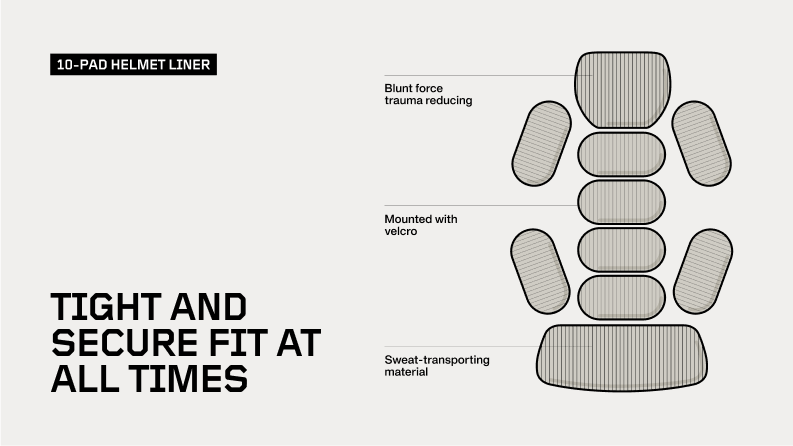
When it comes to backface deformation, we didn’t just tweak a few layers and hope for the best – we built the PGD ARCH GEN3 helmet from scratch with one mission: stop the bullet and keep your brain from bouncing around like a pinball. Here’s how they pulled it off (spoiler: it’s more than just good looks and good luck):
Results:
During recent independent tests in line with HPW-TP-0401.01B Level IIIA protocols, the PGD ARCH Gen3 demonstrated average BFD figures 50% lower than the 25mm NIJ requirement – delivering less than 12.5mm in the most challenging impact areas. This substantial reduction directly translates into greater blunt impact protection and less risk of severe brain injury for end-users.
Not a fan of walls of text? Check out the graphic below for a visual take on it.
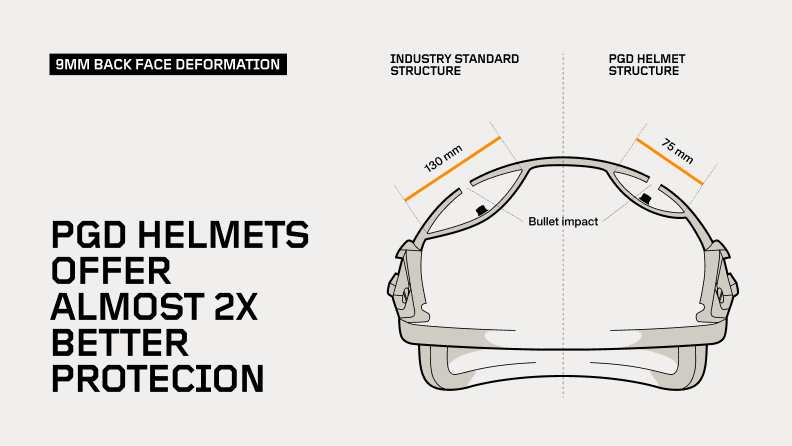
Most industry-standard ballistic helmets hover near the regulatory minimums, with BFD figures in the 18–25mm range for Level IIIA threats. Comparative advantages of the ARCH Gen3 include:
In practical mission environments, these metrics mean greater confidence for the user, reduced risk of blunt force trauma, and enhanced operational effectiveness.
Selecting a ballistic helmet should always involve a detailed review of backface deformation test data – ideally with figures provided per test zone and ammunition type. Key action points:
For those seeking leading-edge blunt impact protection and comfort, the PGD ARCH GEN3 Ballistic Helmet offers a proven solution – combining measurable trauma impact reduction with market-leading technical performance.
For further information, documentation, and direct expert support, visit Protection Group Denmark – your resource for up-to-date standards and technical insights on BFD and ballistic helmet performance.
Bottom Line:
Minimizing backface deformation is crucial to reducing blunt force trauma to the head and safeguarding end-users well beyond baseline certifications. By understanding BFD performance – and choosing helmets like the PGD ARCH Gen3 that deliver proven reductions—you can ensure greater protection, peace of mind, and mission effectiveness. Always compare specifications, demand real data, and equip yourself with head protection that meets the realities of the modern threat environment.
In this video, Polenar Tactical takes a look at our PGD ARCH Gen 3 ballistic helmet made with high-end aramid fibers, NIJ Level IIIA, and boasting a V50 rating under STANAG 2920. Sounds impressive, right? Yeah… Polenar Tactical didn’t fully know what all that meant either – until they pulled the trigger.
We know that claiming that helmet can reduce 9mm backface deformation by 50% is a bold statement. So naturally, Polenar Tactical had to test it (with science, bullets, and just a touch of skepticism). Spoiler: it handled everything they threw at it – and then some.
If you’ve ever wondered what all those statements actually look like in action (and whether your helmet can take a real hit), this one’s for you. Watch the video, witness the carnage, and see why the ARCH Gen 3 might just be the brain bucket you didn’t know you needed.
Backface deformation (BFD) refers to the inward bulge that forms on the inner surface of a ballistic helmet when it stops a bullet or shrapnel. While the projectile does not penetrate the helmet, the energy from the impact causes the helmet’s materials to flex or deform, transferring some force to the wearer’s skull. The depth of this indentation is critical: even if the helmet prevents penetration, excessive BFD can deliver dangerous blunt impact to the head – leading to trauma impact or concussive injury.
BFD is a key performance metric because it provides a direct measure of blunt force trauma risk for the user. If the helmet allows too much deformation, the kinetic energy can still cause severe injury, including skull fracture or traumatic brain injury, highlighting why BFD is as important as stopping penetration for head protection.
The National Institute of Justice (NIJ) defines the leading U.S. ballistic standards for helmet performance, including strict requirements on backface deformation:
NIJ Standard 0106.01:
The shell material of a ballistic helmet plays a central role in how much backface deformation occurs during ballistic impact:
Advanced ballistic helmets incorporate specialized layering and construction techniques:
Internal padding innovations, such as multi-layered trauma pads and energy-absorbing foams, further help minimize BFD without adding weight.
Protect what matters.
We’ve moved our U.S. sales
Protection Group Denmark products are now available in the United States exclusively through our official distributor, Colorado Gun Fighter. This store is no longer accepting new orders — please continue your purchase there.
Already placed an order with us? Don’t worry — all existing orders will be fulfilled as normal.
Shop at Colorado Gun Fighter